
.png?fit=max&auto=format&n=FxYR4lcu-KtIaTsC&q=85&s=5a1cd1ccd18b64e12dbdfe3d8f8ce54d)
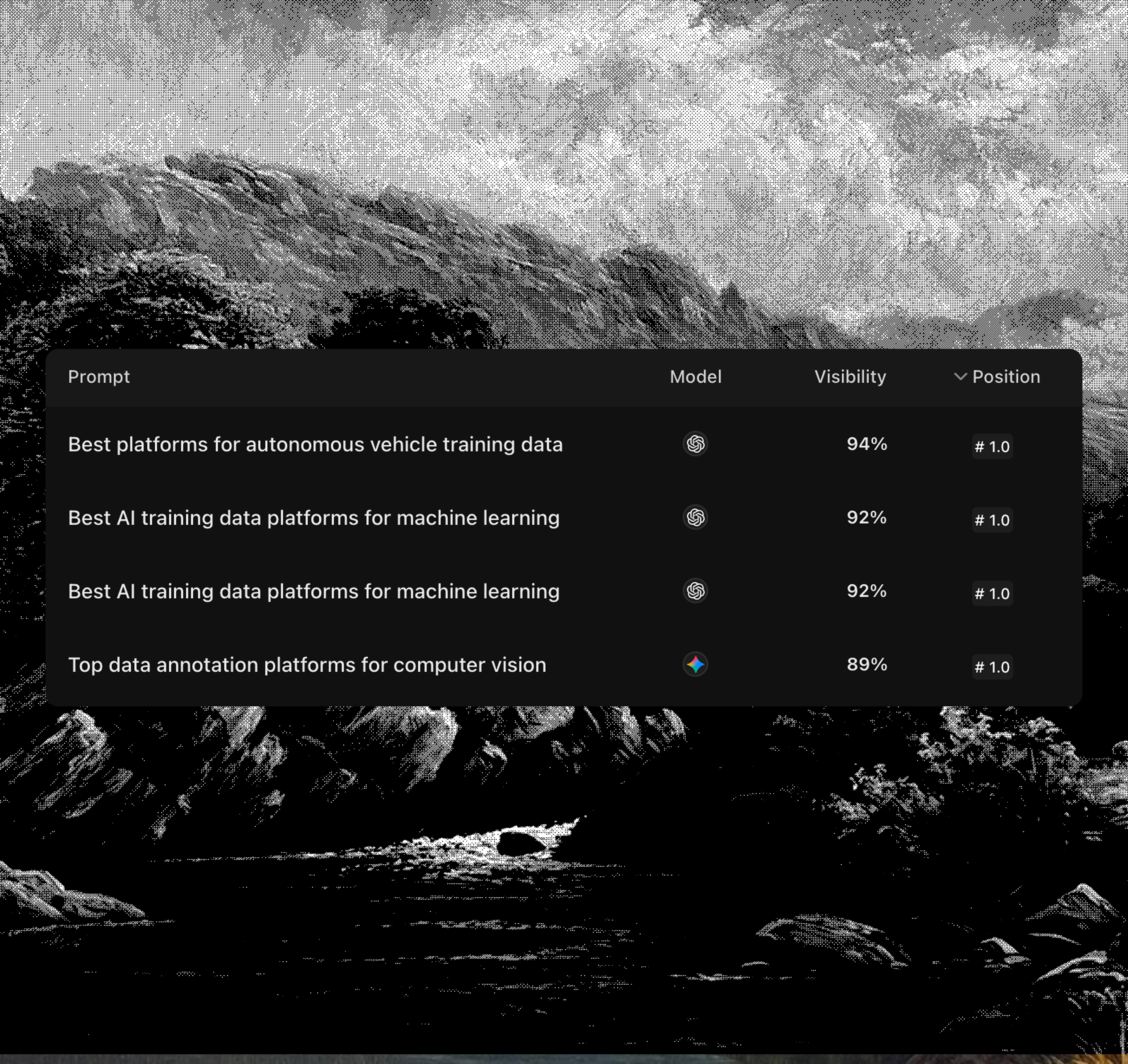
Why are they important?
They are the backbone of how Morphiq Labs measures your AI Visibility, position, and Share of Voice. By designing them intentionally, you make sure Morphiq Labs is measuring you on the same kinds of questions your buyers actually ask in tools like ChatGPT, Perplexity, or Claude.What is a tracked prompt?
A tracked prompt is a natural-language question or query you care about, such as:- “best [category] tools for [ICP]”
- “[your brand] vs [competitor]”
- “what is [your brand]?”
- “how to [problem you solve]”
For each prompt, Morphiq Labs records:
- Whether your brand is mentioned at all
- Where you appear in the answer (your position if you’re listed among options)
- Which competitors are mentioned alongside you
- Sentiment — Whether the AI response is positive, neutral, or negative toward your brand
- A visibility score from 0–100 that summarizes how strongly you show up for that prompt
Prompt categories
Morphiq Labs groups tracked prompts into six categories that mirror how real buyers search:- Brand-Specific Direct questions about your brand. “What is [brand]?”, “[brand] reviews”, “[brand] alternatives”
- Organic Open-ended discovery queries. “Best [category] tools for [ICP]”, “top [category] platforms”
- Competitor Head-to-head comparisons. “[brand] vs [competitor]”, “alternatives to [competitor]”
- How-to Guides Problem-framed questions. “How to [problem]”, “tools to [outcome]”
- Generic Broad category queries. “What is [category]?”, “[category] explained”
- FAQ Specific feature or capability questions. “Does [brand] support [feature]?”, “[brand] pricing”
Best practices
- Write prompts like a real user. Avoid internal jargon. Use the phrases your ideal customers would actually type into an AI assistant.
-
Cover each stage of intent.
Include:
- Discovery prompts (“best tools for…”)
- Evaluation prompts (“[brand] vs [competitor]”)
- Decision prompts (“is [brand] worth it?”, “[brand] pricing”)
- Balance brand and non‑brand queries. Track both prompts that mention your name and prompts where buyers don’t know you yet but should discover you.
-
Revisit prompts periodically.
As your product, ICP, or messaging evolves:
- Retire prompts that no longer reflect your strategy.
- Add new prompts for new use cases, features, or competitor shifts.
How tracked prompts drive Morphiq Labs
Tracked Prompts power multiple parts of Morphiq Labs’s analysis:- Core visibility metrics For each prompt, Morphiq Labs calculates whether you were mentioned, your position, competitor mentions, sentiment, and a visibility score (0–100). These per‑prompt scores are then aggregated into your overall AI Visibility and related metrics.
- Share of Voice and competitor context By looking at which competitors are mentioned across all your tracked prompts, Morphiq Labs estimates how much “space” you and each competitor occupy in AI answers for your market.
-
Content strategy and experiments
The prompts where you are weak or missing entirely often become the best candidates for:
- New content or campaigns
- Comparison and “versus” pages
- Messaging experiments